

Reviewed by Clayton Ayling BSc (Hons) MRICS MPTS, Chartered Building Surveyor — Updated 24 April 2026
Party Wall Act Section 6
Section 6 of the Party Wall etc. Act 1996 governs excavation work near neighbouring buildings. It requires a building owner to serve notice before carrying out excavation that falls within one of two statutory geometry tests — the 3 metre rule or the 6 metre rule — both defined by the relationship between the proposed excavation and the existing foundations of the adjoining owner’s building.
Section 6 does not prevent excavation. It requires the building owner to follow a process: serve notice, allow the adjoining owner to respond, and either proceed under consent or under a party wall award prepared by appointed surveyors.
What It Is
The section of the Act that governs excavation near neighbouring buildings — requiring notice before works start.
When It Applies
When excavation falls within 3 or 6 metres of an adjoining building and meets the relevant depth test.
Why It Matters
Working without notice where section 6 applies exposes the building owner to injunction and damages claims.
The key point
Section 6 requires notice, not consent. The adjoining owner can dissent and appoint a surveyor, but cannot block works that are otherwise lawful. The process manages risk and records the condition of the neighbour’s property before excavation begins.
Send us the proposed foundation drawings and a site plan. We will confirm which section 6 triggers apply and draft the notice.
Contact us →The two triggers
Section 6 contains two independent tests. Either can apply on its own. On deeper projects — basements, piling, underpinning — both commonly apply at the same time, but only one notice needs to be served.
3 metre rule
Applies where the excavation falls within three metres of the adjoining building and goes deeper than the bottom of their existing foundations.
6 metre rule
Applies where excavation within six metres of the adjoining building would cut below a line drawn at 45 degrees from the base of their foundations.
The 3 metre rule
The 3 metre rule is the trigger most commonly encountered on residential extension and basement projects. Both a distance test and a depth test must be satisfied.
The three metres is measured horizontally from the nearest part of the adjoining owner’s building — not from the boundary line. The depth test runs from the bottom of their existing foundations, not from their ground level.
For a detailed look at this rule and the practical examples it catches, see the Party Wall Act 3 metre rule guide.
The 6 metre rule
The 6 metre rule applies where excavation within six metres of an adjoining building would cut below a line drawn downwards at 45 degrees from the bottom of that building’s existing foundations. It typically catches deeper works: piled basements, lift pits, and deep underpinning.
The 45-degree line starts at the base of the neighbour’s foundations and runs towards the proposed excavation. If any part of the excavation falls below that line and within six metres of the building, the rule applies.
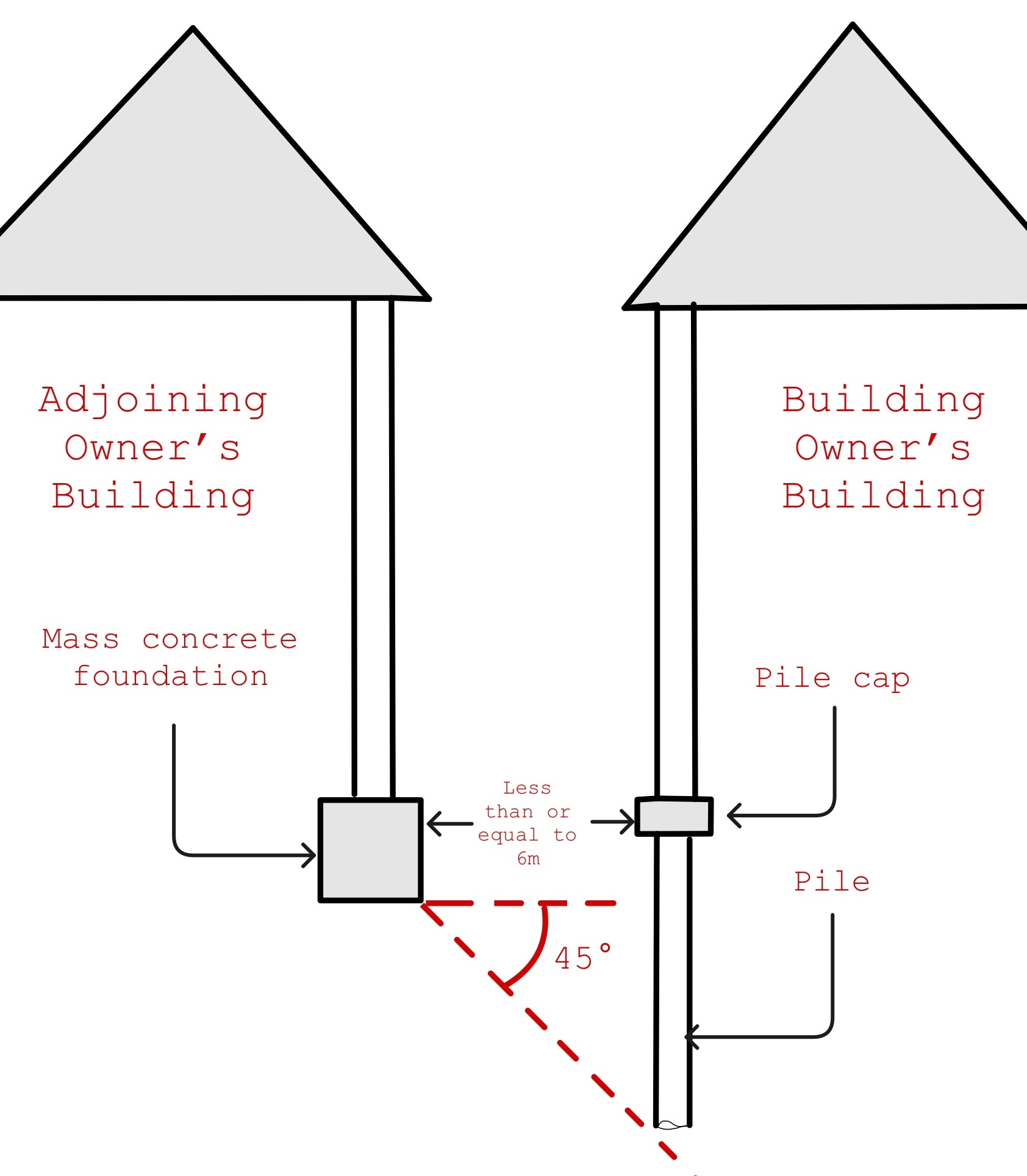
Both the 3 metre and 6 metre rules must be checked on every project that involves excavation near a boundary. Checking one and missing the other is a common source of programme delay.
The section 6 notice
A section 6 notice — required whether the 3 metre or 6 metre trigger applies — is a formal statutory document. Defects in content or service can invalidate it and force re-service, which delays the programme.
- The name and address of the building owner.
- The address of the site on which the works are proposed.
- A description of the proposed excavation, with plans and sections showing depth and position.
- The proposed start date, with at least one month's notice before works begin.
For the general rules on service and timing, see the party wall notice guide.
What happens after service
The adjoining owner has 14 days from service to respond. They can consent in writing, dissent in writing, or do nothing — which the Act treats as a deemed dispute. In a dispute, surveyors are appointed and a party wall award is drawn up before excavation can start.
Consent
The adjoining owner agrees in writing. Works can proceed, though a schedule of condition is advisable to record the pre-works state of their property.
Dissent or no response
Surveyors are appointed. A party wall award is drawn up, setting out how the works must proceed and providing a mechanism for resolving any damage that arises.
Schedule of condition
A schedule of condition records the state of the adjoining property before excavation begins. It is not a statutory requirement under section 6, but it is the most practical protection available to both parties if damage is later alleged.
Without a photographic record taken before works start, any dispute about pre-existing defects versus excavation damage becomes difficult to resolve. The award commonly provides for a schedule of condition to be prepared as part of the process.
Common mistakes
- Assuming section 6 only catches basements. Extension foundations within three metres of a neighbour's building trigger the rule just as readily.
- Measuring from the boundary rather than from the nearest part of the neighbour's building.
- Using the neighbour's ground level as a proxy for foundation depth. The test runs from the bottom of their foundations, not the surface.
- Overlooking the 6 metre rule because the 3 metre rule appears to be the only trigger. Both must be checked on every project involving excavation near a boundary.
- Starting excavation during the 14-day response period. That converts a procedural issue into an injunction risk.
- Relying on verbal agreement rather than a written consent or award.
Does section 6 apply to your project?
If your drawings show excavation anywhere along a boundary, a short review against the Act before tender avoids the programme colliding with the statutory notice period.
See our party wall surveyor service or compare this page with the guides on the 3 metre rule, party wall notice, party wall award, and the Party Wall Act 1996.
Related knowledge
Compare this article with the nearest matching pages if you want to follow the topic into related surveying questions.
Plain-English guide to the Party Wall etc. Act 1996 — what the legislation covers, which works are notifiable under sections 1, 2 and 6, how the notice and award process runs, the role of the surveyor, and the consequences of proceeding without compliance.
Plain-English guide to the 3 metre rule under section 6 of the Party Wall etc. Act 1996 — how the distance and depth tests work, when a notice is required, what must be included, and how it interacts with the 6 metre rule on deeper projects.
Plain-English guide to the party wall notice under the Party Wall etc. Act 1996 — when it is required, how it must be served, statutory notice periods, and the options open to the adjoining owner on receipt.
Plain-English guide to party wall awards under the Party Wall etc. Act 1996 — when an award is required, what it contains, how it is produced by appointed surveyors, how it is appealed, and how it governs works on site.
Key Services
Need a surveyor rather than another article?
If this article relates to a live property issue, one of these service pages is likely to be the most useful next step.
Lease-end claims
Dilapidations
Landlord and tenant advice on schedules, quantified demands, lease interpretation, and negotiated settlement.
Explore DilapidationsNeighbourly matters
Party wall matters
Notices, adjoining owner response, schedules of condition, awards, and practical support before works start.
Explore Party wall mattersLease protection
Schedules of condition
Condition recording for lease commencement, pre-works evidence, and later protection against dispute over pre-existing condition.
Explore Schedules of condition