

Reviewed by Clayton Ayling BSc (Hons) MRICS MPTS, Chartered Building Surveyor — Updated 22 April 2026
What Are Party Walls?
A party wall is a wall that stands on the land of two or more owners and, as a result, is regulated by the Party Wall etc. Act 1996. The concept includes the shared dividing wall between terraced or semi-detached houses, the floor-and-ceiling structure between flats, and certain free-standing boundary walls. It excludes fences, hedges, and walls that stand wholly on one owner’s land.
Identifying whether a wall is a party wall matters because the Act only applies to party structures. This page explains the definition, the common types, the walls that look like party walls but are not, and why this categorisation drives every subsequent step in the party wall process. For help on a live project, see the party wall surveyor service.
What It Is
A wall — building or boundary — that stands on the land of two or more owners and is regulated by the Party Wall etc. Act 1996.
When It Matters
Whenever one owner wants to carry out works that touch, cross, or come close to a shared wall or boundary.
Why It Matters
The Act’s notice, consent and award framework only applies if the wall is in fact a party wall.
The key point
If in doubt, treat the wall as a party wall and take advice. It is far cheaper to confirm at the planning stage than to discover mid-project that a notice should have been served. Chartered surveyors can resolve the question quickly.
Not sure whether your wall is a party wall? Tell us where it sits and what you want to do, and we will tell you whether the Act is engaged.
Contact us →The statutory definition
The Party Wall etc. Act 1996 defines a party wall by reference to its position and use, not by reference to the original builder. The key test is whether the wall stands on the land of two or more owners, either forming part of a building or standing free as a boundary wall.
Even where a wall forms part of one building only, it can still be a party wall if it sits astride the boundary. What matters is the wall’s physical relationship to the boundary line, not who uses it day to day.
The types of party wall
- Type A: a wall that forms part of a building and stands on the land of two or more owners — the classic terraced or semi-detached dividing wall.
- Type A: a wall that forms part of a single building but stands on the land of more than one owner, even where only one owner uses it.
- Type B: a wall that stands wholly on one owner’s land but has been enclosed upon by the adjoining owner’s building — treated as a party wall to the extent of the enclosure.
- A free-standing boundary wall, built of brick or other solid material, that sits astride the boundary line between two properties — known as a party fence wall.
- A floor structure that separates different ownerships in a building, such as a flat above a commercial unit.
For a focused look at free-standing boundary walls see the party fence wall guide, and for the broader boundary position see boundary walls.
Type A and Type B shown simply
Surveyors commonly describe the two main wall arrangements as Type A and Type B. The government’s Party Wall etc. Act 1996 explanatory booklet uses the same distinction: Type A is the classic wall astride the boundary; Type B is a wall that stands wholly on one owner’s land but is used to separate both buildings.
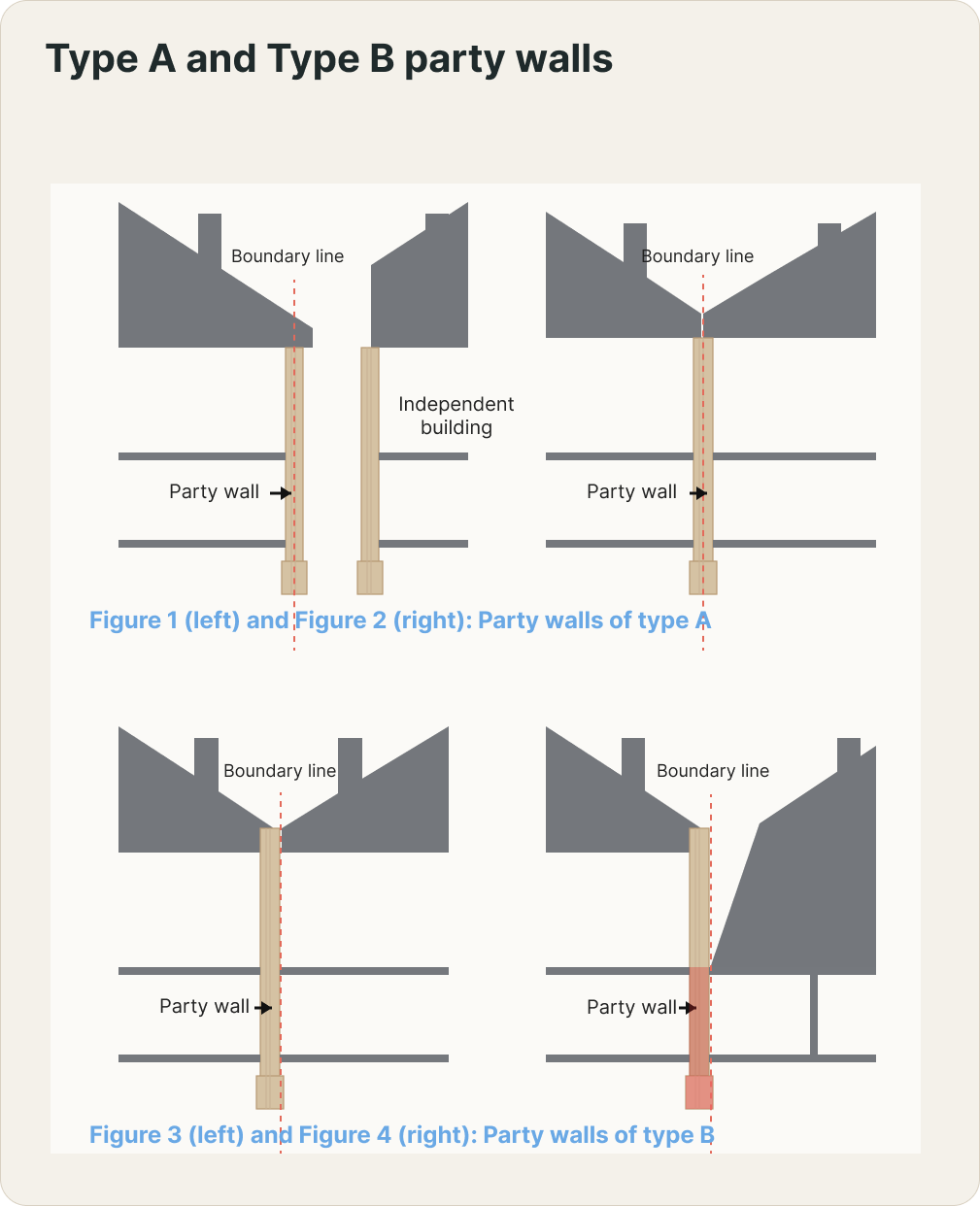
The practical difference matters. Figures 1 and 2 show two type A arrangements, where the party wall stands astride the boundary. Figures 3 and 4 show type B arrangements, where the wall stands wholly on one owner’s land and only the separating section is party. That is why surveyors pay close attention to the precise line of the wall, the boundary, and the extent of the adjoining enclosure.
Walls that are not party walls
Not every wall between neighbouring properties is a party wall. Some look like they should be, but fall outside the Act.
- A timber close-board or panel fence, even where it sits exactly on the boundary.
- A chain link fence, hedge, or purely decorative boundary feature.
- A wall that stands wholly on one owner’s land and serves only that property.
- An internal wall within a building that is in a single ownership.
Ownership and maintenance
Joint ownership
Most party walls are jointly owned, with each owner holding the half on their side of the boundary subject to the other’s statutory rights.
Joint maintenance
Maintenance of a party wall is normally a shared responsibility, with costs apportioned according to use or benefit.
The legal framework
The Party Wall etc. Act 1996 sets out the statutory rules for notifying neighbours, resolving disputes, and authorising works that affect party structures.
For a detailed look at the Act and its reach see the Party Wall Act 1996 guide. The Government's own explanatory booklet on the Party Wall etc. Act 1996 (Ministry of Housing, Communities and Local Government) remains the standard plain-English guide to how the Act works in practice, and the RICS guidance note on party wall legislation and procedure (7th edition) is the professional standard chartered surveyors are expected to follow on a notifiable project.
Why correct identification matters
- Works to a party wall are regulated — not banned — by the Act.
- Identifying a party wall correctly at the start of a project saves weeks later in notice periods and surveyor appointments.
- A misidentified wall leads to missed notices, potential injunctions, and avoidable cost.
- Both owners have rights under the Act — not just the building owner carrying out the works.
Need to identify a party wall on your project?
Whether you are designing an extension, planning a loft, or responding to a neighbour’s notice, the first question is always whether the wall in question is a party wall. That single answer drives every later decision.
See the party wall surveyor service or read the related guides on party fence walls, boundary walls, and party wall agreements.
Related knowledge
Compare this article with the nearest matching pages if you want to follow the topic into related surveying questions.
Plain-English guide to the Party Wall etc. Act 1996 — what the legislation covers, which works are notifiable under sections 1, 2 and 6, how the notice and award process runs, the role of the surveyor, and the consequences of proceeding without compliance.
Explore the essentials of party fence walls in London and the South East with our expert surveying services. Understand your rights, responsibilities, and how to manage disputes under the Party Wall etc. Act 1996. Get professional support for a harmonious…
Plain-English guide to party wall agreements under the Party Wall etc. Act 1996 — what the agreement is, when one is needed, what it contains, and the process of getting one in place through written consent or a formal Award.
Explore the essential facets of building against a party wall with our comprehensive guide. Understand the legal framework, types of works, and best practices for maintaining harmonious neighbour relations in London and the South East.
Key Services
Need a surveyor rather than another article?
If this article relates to a live property issue, one of these service pages is likely to be the most useful next step.
Lease-end claims
Dilapidations
Landlord and tenant advice on schedules, quantified demands, lease interpretation, and negotiated settlement.
Explore DilapidationsNeighbourly matters
Party wall matters
Notices, adjoining owner response, schedules of condition, awards, and practical support before works start.
Explore Party wall mattersLease protection
Schedules of condition
Condition recording for lease commencement, pre-works evidence, and later protection against dispute over pre-existing condition.
Explore Schedules of condition